Coles Pay: Validating gift card redemption experiences
Overview
Led usability research for Coles Pay’s gift card checkout experience, identifying key customer behaviours and reducing uncertainty before launch.
Key responsibilities
Research Planning
Usability Testing
Participant Recruitment
Insight Synthesis

Research Overview
15
Participants
9
Key Assumptions Tested
2
Prototype Variations Evaluated
4
Product Decisions Informed
Gift Cards were being introduced into checkout
Coles Pay brings together multiple payment methods in a single checkout experience, including payment cards, Flybuys points, and gift cards.
As gift cards were introduced, we needed to understand whether they added value or complexity. While gift cards are familiar on their own, they create new questions when combined with other payment methods.
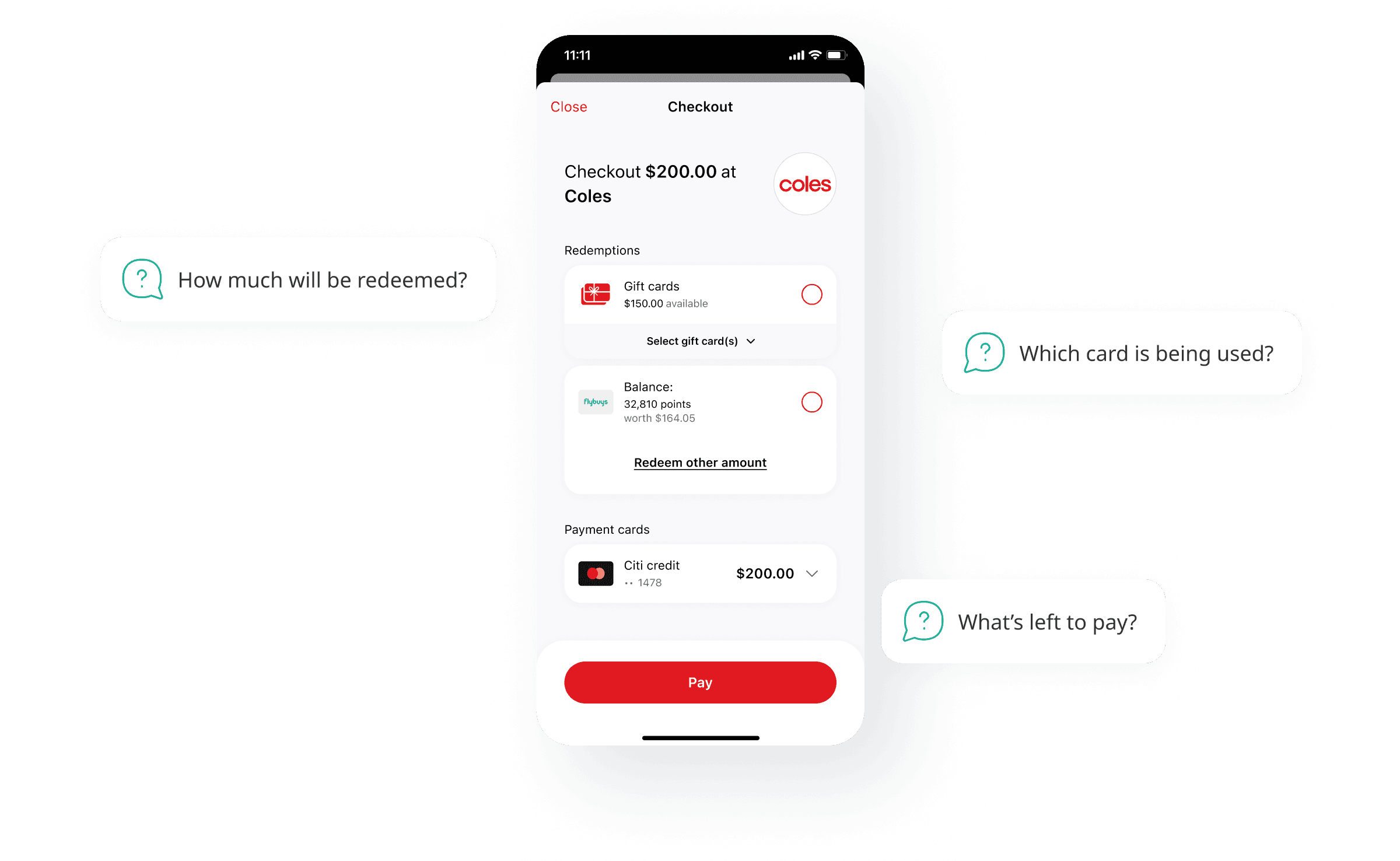
More than just another payment method
Adding gift cards wasn't simply about introducing another payment method. It was about ensuring customers could still understand where their money was coming from and where it was going.
Before moving forward, we wanted to understand how customers expected gift cards to work.
What we tested
We tested the experience with Flybuys members who regularly shop for groceries online and have experience using gift cards.
One key decision was how gift cards should be redeemed. Should they be applied automatically, or should customers choose when to use them?
To understand what customers expected, we tested two different approaches.

Automatic redemption
Gift cards were automatically applied during checkout.

B. Manual redemption
Customers selected and applied gift cards themselves.
Rather than deciding which option was better, we wanted to learn how customers expected gift cards to work.
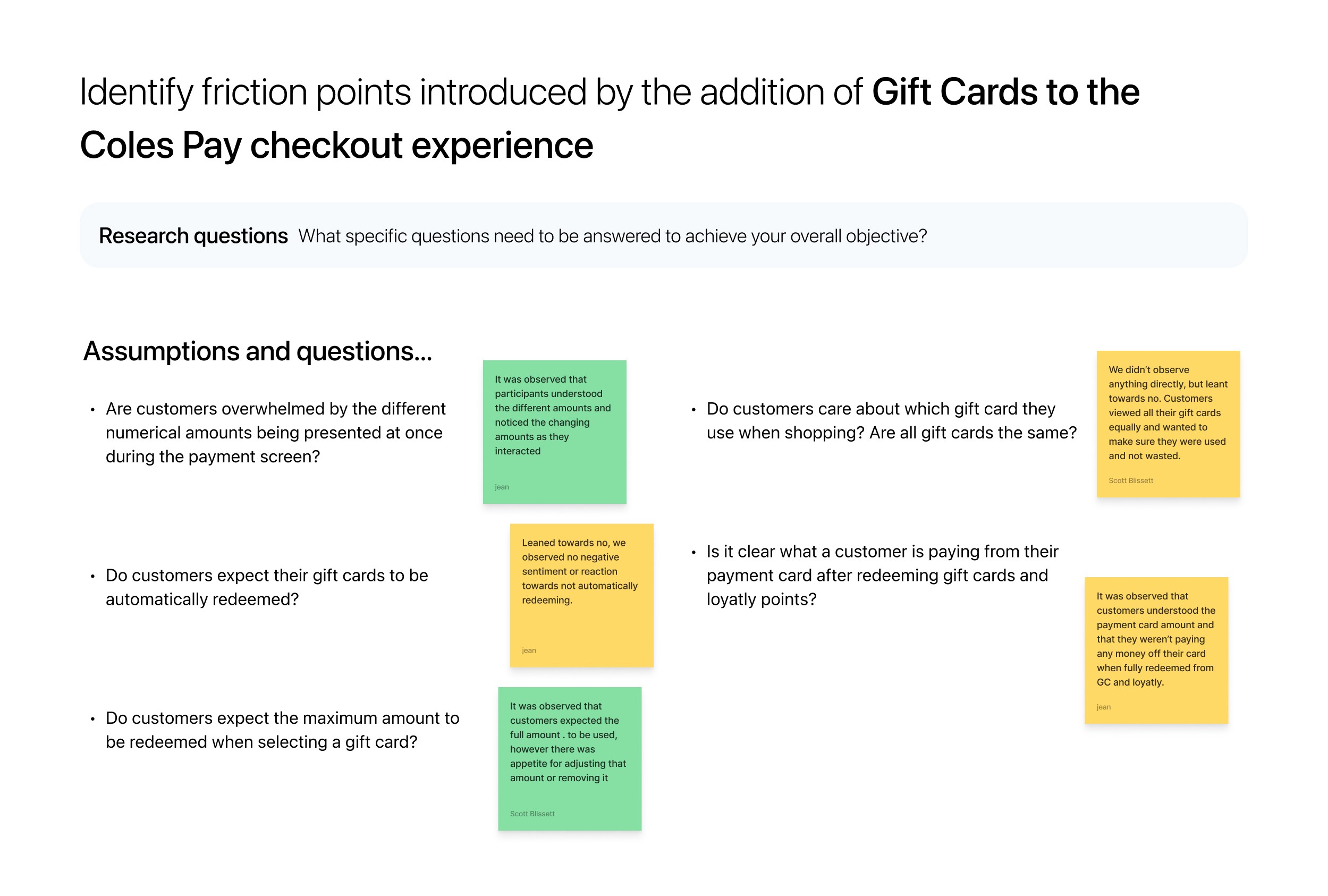


What we validated
01.
The payment model was understood.
Customers could easily follow how gift cards, Flybuys points, and payment cards worked together. The payment hierarchy felt intuitive and did not create significant confusion.
02.
Customers wanted to maximise value.
Most expected the highest possible gift card amount to be redeemed automatically, with partial redemption only useful when the card balance exceeded the order total.
03.
Automatic redemption wasn't a major concern.
Whether gift cards were applied automatically or manually had little impact on customer behaviour.
04.
Flexibility still mattered.
Some customers preferred saving gift cards for future purchases, suggesting redemption should remain optional.
The impact
The research helped reduce uncertainty around introducing gift cards into the checkout experience.
Rather than uncovering major usability issues, it validated that customers could comfortably navigate multiple payment methods when the payment breakdown was clear. It also gave the team confidence to move forward with a simpler redemption experience.
The findings directly informed decisions around payment hierarchy, full-balance redemption, amount editing, and future support for multiple gift cards.